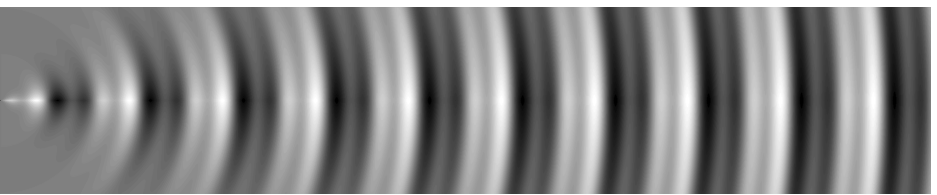
 Exemple of soundfield generated by a périodic point source
 Exemple of soundfield generated by a périodic point source
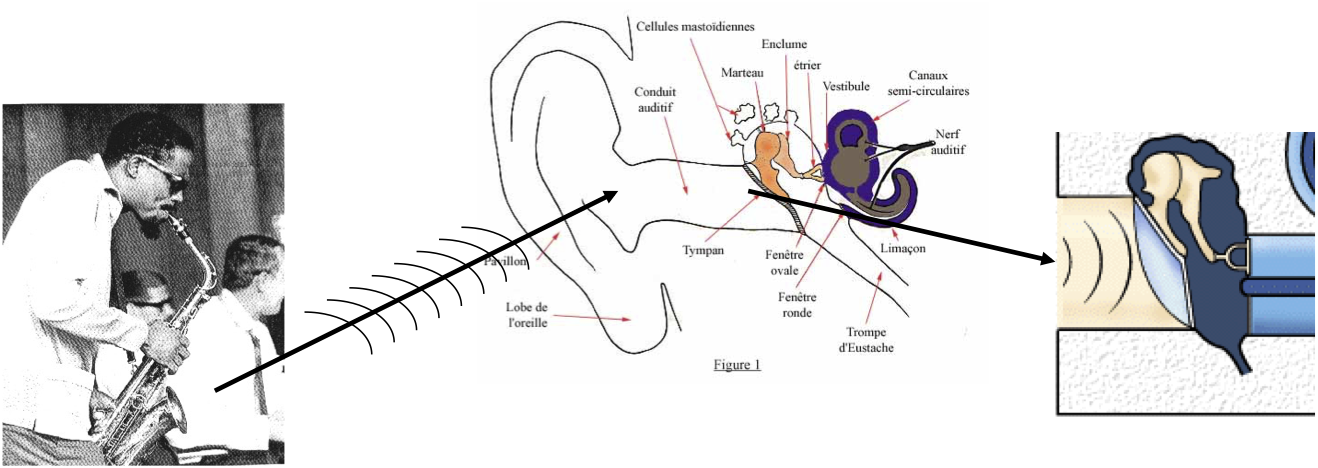 The information on the source is carried out by the acoustic wave from the source to the listener
Sound waves are generated by sources that force oscillations of air …
Sound waves propagate from the source to the receiver (ear, microphone, …)
A sound wave is a mechanical wave, the celerity (sound speed) depends on the medium properties
Air vibration can be forced by vibrations of plates, membranes, shells, etc.
These sources can be caracterized as vibroacoustic sources
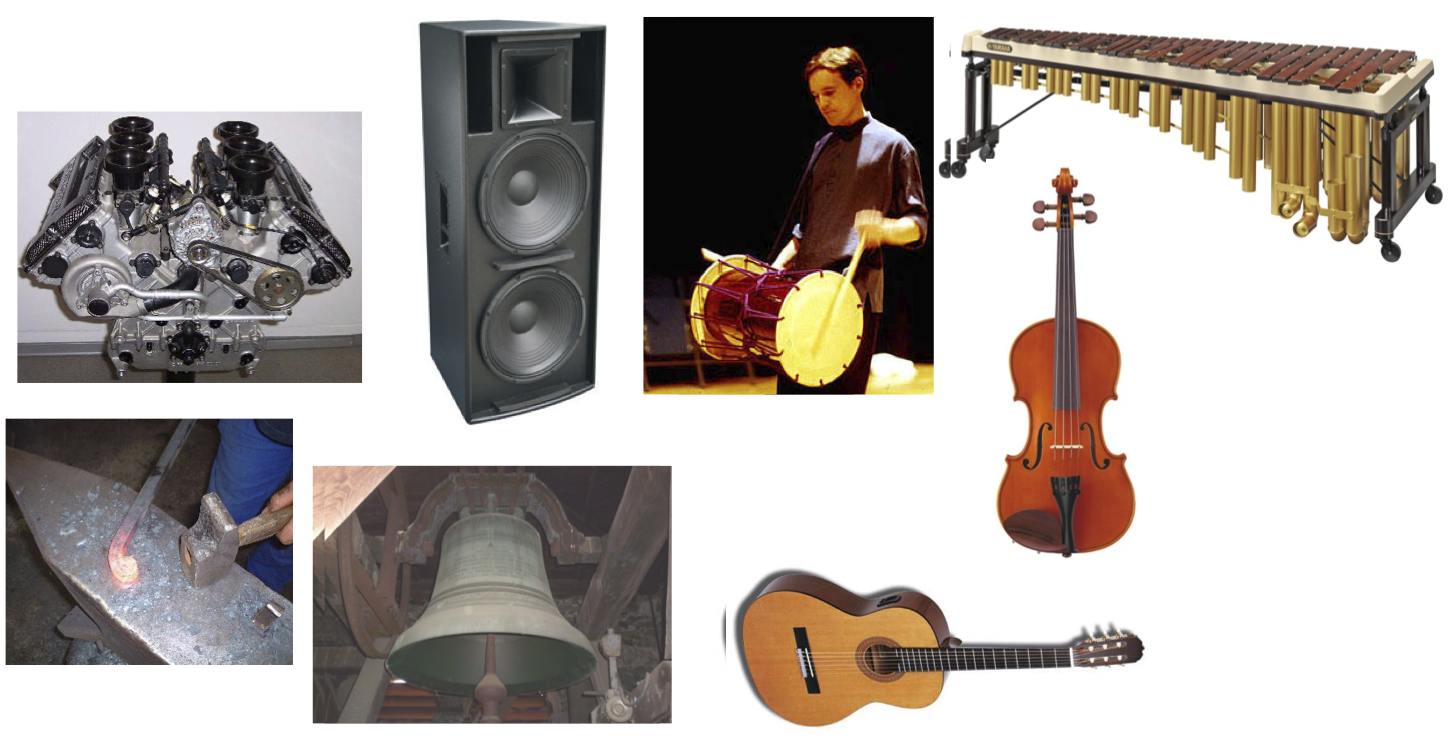 Examples of vibroacoustic sources
Jets and valves sources can generate air vibrations.
Most wind instruments are baased on the modulation of a jet (flutes, recorders), of the modulation of a static prressure by a vibrating reed (clarinet, saxophone, oboe, accordion, … etc) or by lips vibrations (brass instruments).
The voice is also an aeroacoustic source: the vocal folds modulate the flow.
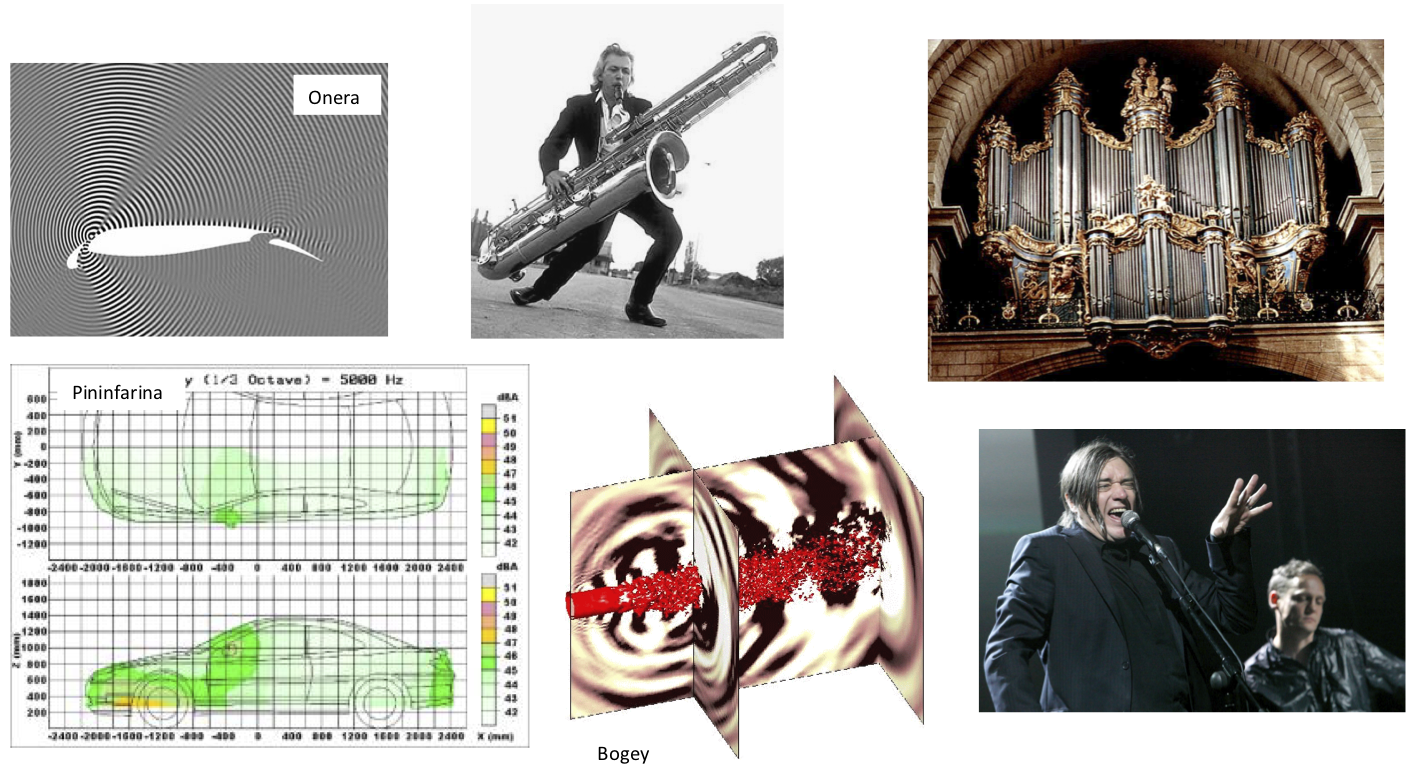 Examples of aeroacoustic sources
Musical instruments can be categorized in two main categories
Many instruments can be described as free oscillating systems that are excited by an initial excitation. After the Attack, they vibrate at frequencies that correspond to the eigen-frequencies of the main resonator (string, membrane, bar, shell, …). Then the oscillations decay due to the damping of the eigen-modes.
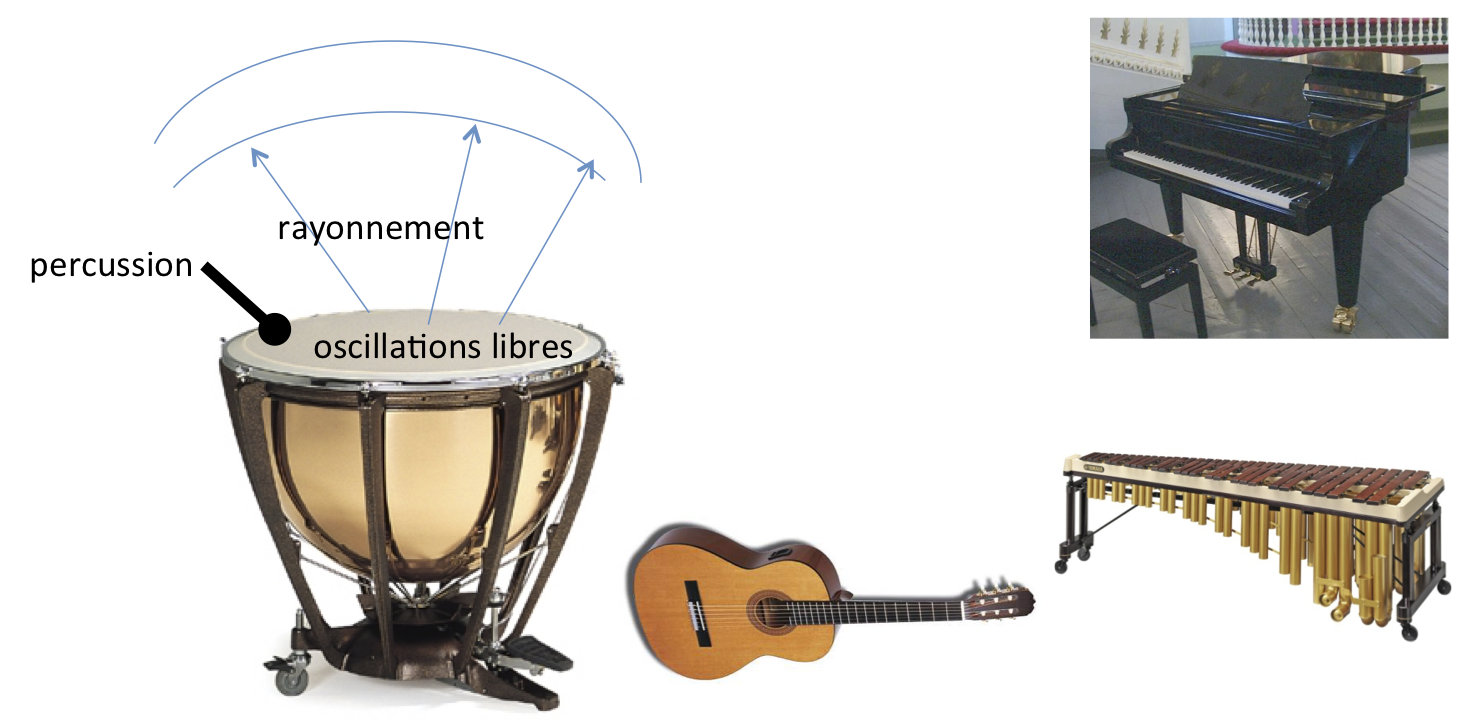 Examples of free oscillators
Most musical instruments that generate continous periodic sounds can be described as self-seustained oscillators. These dynamical system caan be described as nonlinear feed-back looped systems that convert a static source of energy (blowing pressuree, continuous jet, bow velocity, …) to a sustained oscillation.
Wind instruments (flute and recorder, reed instruments, brass instruments, accordion, etc), and bowed string instruments (violin, cello, etc) can be modeled by a feed-back loop nonlinear system.
 Examples of Self-sustained oscillators
Sound is a mechanical waves: There is no sound in vacuum !
Sound needs a medium !
Soundwaves are longitunal waves.
Videos :
Exemple of soundfield generated by a périodic point source
An acoustic wave is often characterized as a propagating or a standing wave of pressure fluctuation p(x,y,z,t).
The acoustic pressure can be measured quiet easily with microphones
Other quantities are used to characterize sound or acoustic waves, mainly the velocity v(x,y,z,t) of vibrating particles or air, and the density variations \rho(x,y,z,t), but these two latter quantities are more difficultly measured than pressure.
Pressure variations p(x,y,z,t) and local air density \rho(x,y,z,t) are related, hence waves with shocks, i.e. with high pressure level and steep pressure rise \frac{\mathrm{d} p}{\mathrm{d} t} can be visualized by using optical techniques like Schlieren strioscopy.
This technique is well known for strong shock and thermal field visualization.
It has been used more than 100 years ago to observe shockwaves [Arthur L. Foley and Wilmer H. Souder,“A New Method of Photographing Sound Waves,” Physical Review, 35, no. 5, 1912]
It has been used in architectural acoustics since 1912 to observe early reflections of sound in 2D models of halls (Fischer, 2017)
It is used at the LMFA to study the propagation and the reflection acoustic waves with shocks (Desjouy 2016)[http://acoustique.ec-lyon.fr/publi/desjouy_pof16.pdf]
[…]
–